

Facial Contouring
Chin Surgery (Genioplasty) in Seoul
A chin line that suits your face, not an exaggerated change.
The chin tip does outsized work in how a face's proportions and dimensionality read. Adjusting its length, position, and angle to fit the rest of the face — not to a fixed ideal — improves balance for a short, blunt, long, or asymmetric chin alike.
The chin tip is small, but it anchors how the whole lower face reads — proportion, symmetry, even how the lips appear to sit. Because the mandibular nerve runs directly through the area being worked on, every technique is planned against detailed anatomical imaging first, chosen specifically for the shape in front of the surgeon, not applied as a default.
“A chin line that suits your face, not an exaggerated change.”
Dr. Lee references the Ricketts line, a guide where — measured from nose tip to chin tip — the upper lip sits about 4mm and the lower lip about 2mm back, while accounting for the mandibular nerve running through the chin area, to plan a safe and precisely tailored correction.
Chin surgery is commonly combined with jaw or cheekbone work by international patients planning facial contouring in Korea, but it's also frequently requested on its own by patients whose only concern is chin length, position, or symmetry — both paths start with the same Ricketts-line analysis during consultation.
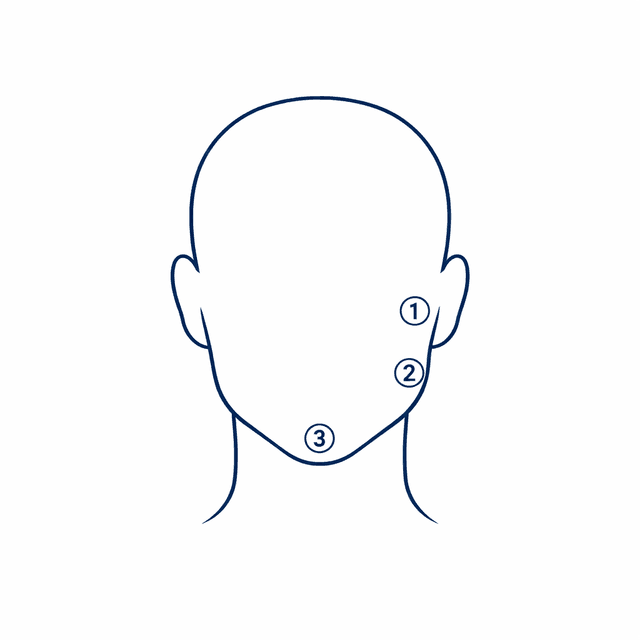
Know Your Anatomy
Which part of your facial structure is the concern? Tap to see the matching procedure.
Recovery & Follow-Up at a Glance
Clinic visits, stitch removal, and recovery time below are in addition to our standard aftercare — swelling management, infection prevention, and scar care through full recovery.
Duration
About 1 hour
Anesthesia
General or sedation
Hospital Stay
Day surgery
Clinic Visits
1–5 visits
Recovery
About 2 weeks
Planning Your Trip to Korea
We recommend staying in Korea for 14 days (7-day minimum if your schedule is tight).
Follow-up clinic visits are scheduled on day 1, day 7, day 14 after your procedure.
Complimentary daily swelling-reduction laser sessions are included throughout your stay — visit as often as you'd like.
Is this right for you?
- A short or recessed chin making the face look flat
- A long or protruding chin giving a strong or unbalanced impression
- A recessed or underdeveloped chin distorting face shape
- Asymmetry or an awkward-looking chin line you'd like improved
Not sure yet? Send a photo on WhatsApp and Dr. Lee Hee-young's team will give you an honest, no-obligation read before you decide anything.
Send a Photo on WhatsAppWhich One Matches You?
These aren't interchangeable options — each addresses a different underlying structure. Dr. Lee confirms which one fits your case during consultation.
Wide Chin
Removes a central bone segment via a T-osteotomy and brings the remaining chin together for a slimmer line from the front.
- 01Remove the central bone segment through an intraoral incision
- 02Bring the remaining bone together, reposition, and fix firmly
- 03Refine any secondary angle created by the fixation
Long Chin
Osteotomizes the chin tip horizontally, removes a bone segment, and raises the lower portion to shorten overall chin length.
- 01Remove bone along the horizontal osteotomy line
- 02Raise and fix the lower bone segment to reduce length
- 03Refine any protruding side bone
Short Chin
Osteotomizes around a central bone segment and repositions removed bone above it to extend length and refine width together.
- 01Design according to the needed extension length and width
- 02Osteotomize, preserving the central bone segment
- 03Reposition removed bone on either side of the preserved central segment
- 04Fix firmly and refine the side bone line
Retrogenia
Osteotomizes the chin tip horizontally and advances it forward before fixing it in the new position.
- 01Osteotomize the chin tip horizontally
- 02Advance the chin tip forward and fix in place
Safety & What We'll Discuss
Because the mandibular nerve runs directly through the chin, temporary numbness in the lower lip or chin is a known short-term risk of chin surgery — Dr. Lee will explain how your specific anatomy affects that risk during consultation.
Why Uni
Designed to the ideal line
Considering dimensionality from front, side, and 45° angles, chin length, angle, and position are precisely analyzed and designed against the Ricketts line.
A plan grounded in anatomical structure
Because the mandibular nerve runs through the chin, precise anatomical analysis beforehand informs a surgical plan that carefully accounts for nerve position to avoid unnecessary damage.
A technique matched to your face and condition
Chin shape, facial proportion, and bone structure are comprehensively analyzed to select the most suitable technique for each individual, for an ideal contour that blends naturally with your face.
What You Can Expect
Frequently Asked Questions
What's the difference between Wide Chin vs. Long Chin vs. Short Chin vs. Retrogenia?
Wide Chin — Removes a central bone segment via a T-osteotomy and brings the remaining chin together for a slimmer line from the front. Long Chin — Osteotomizes the chin tip horizontally, removes a bone segment, and raises the lower portion to shorten overall chin length. Short Chin — Osteotomizes around a central bone segment and repositions removed bone above it to extend length and refine width together. Retrogenia — Osteotomizes the chin tip horizontally and advances it forward before fixing it in the new position.
How do I know which type applies to me?
Most patients can't tell from a mirror alone — wide chin and long chin can look similar until Dr. Lee examines the underlying structure. Send a photo on WhatsApp for an initial read, then an in-person consultation confirms exactly which type fits your case before any decision is made.
How long is recovery, and how many days should I plan to stay in Korea?
Initial recovery takes about About 2 weeks. We recommend planning to stay in Korea for about 14 days (7-day minimum if your schedule is tight) so we can see you through your follow-up visits.
Will the results look natural?
Yes. A chin line designed against an established aesthetic guideline, not guesswork A plan that accounts for the mandibular nerve to avoid unnecessary damage
Our care philosophy
A trustworthy care system — named physicians only, no ghost surgery.
Responsible medicine — the operating surgeon sees the case through from start to finish.
Patient safety first — precise pre-op workup and planning, minimized tissue damage during surgery.
Aftercare that doesn't stop at discharge — swelling management, infection prevention, scar-care program.
Individual results vary. As with any surgery or procedure, this carries risks and possible side effects. Dr. Lee reviews your specific risk factors, alternatives, and what to expect in detail during your consultation before any decision is made.
Plan Your Chin Surgery (Genioplasty) With Dr. Lee Hee-young
Book a Free Consultation