

Nose
Revision Rhinoplasty in Seoul
Rebuilding the structure a first rhinoplasty left unresolved — more carefully, this time.
Revision rhinoplasty isn't a cosmetic touch-up — it's a structural rebuild. A CT scan helps, but prior surgery or scar contracture can hide details a scan alone won't catch, so Dr. Lee combines imaging with hands-on assessment built from a high volume of revision cases to plan around what's actually happening inside the nose.
Materials matter as much as technique. A graft that worked well in one nose can fail in another depending on skin thickness, how much scar tissue is already present, and what the original surgery used. Choosing between septal cartilage, ear cartilage, dermis, or rib cartilage — donor or the patient's own — is a decision made after assessing what's actually left to work with.
“Rebuilding the structure a first rhinoplasty left unresolved — more carefully, this time.”
Tissue generally needs about six months to stabilize before a safe, effective second surgery — sooner only if there's active inflammation that needs addressing first. From there, every case is planned individually: what caused the problem, what condition the existing implant or cartilage is in, what material fits best this time, and what structural points this surgery has to get right.
Revision rhinoplasty is one of the more common reasons international patients seek a second opinion in Korea specifically, given the concentration of surgeons here with high case volumes in complex nose revisions. Bringing prior surgical records or CT scans to your consultation, where available, helps Dr. Lee plan more precisely from day one.
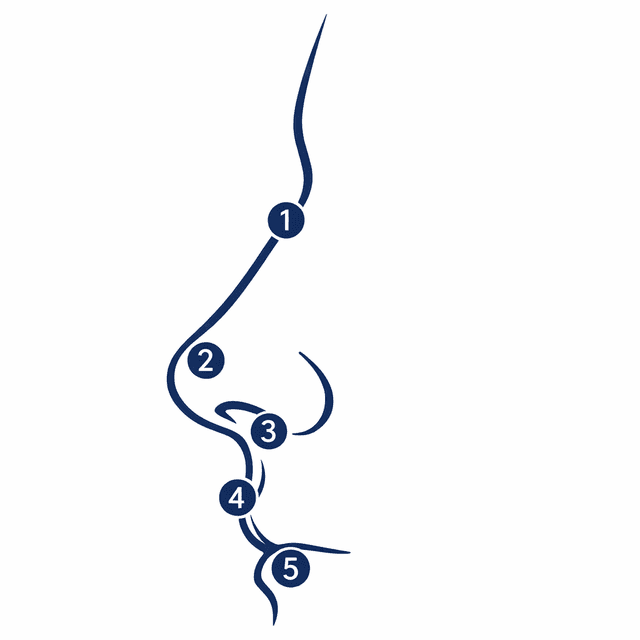
Know Your Anatomy
Which part of your nose is the concern? Tap to see the matching procedure.
Recovery & Follow-Up at a Glance
Clinic visits, stitch removal, and recovery time below are in addition to our standard aftercare — swelling management, infection prevention, and scar care through full recovery.
Duration
About 2 hours
Anesthesia
Local or sedation
Clinic Visits
3 visits
Hospital Stay
None
Stitch Removal
7 days
Planning Your Trip to Korea
We recommend staying in Korea for 14 days (7-day minimum if your schedule is tight).
Follow-up clinic visits are scheduled on day 3, day 7, day 14 after your procedure.
Complimentary daily swelling-reduction laser sessions are included throughout your stay — visit as often as you'd like.
Is this right for you?
- A previous rhinoplasty that didn't resolve as expected
- A bridge that has shifted or curved since the first surgery
- An implant that's visible or shows through the skin
- A nose line that looks unnatural, or a tip that's lifted or see-through
Not sure yet? Send a photo on WhatsApp and Dr. Lee Hee-young's team will give you an honest, no-obligation read before you decide anything.
Send a Photo on WhatsAppFrom Dr. Lee's Channel
Watch: Rhinoplasty Materials, Explained
Watch: What to Know Before Autologous Rib Cartilage Rhinoplasty
Which One Matches You?
These aren't interchangeable options — each addresses a different underlying structure. Dr. Lee confirms which one fits your case during consultation.
Tip Contracture
Releases tissue hardened and adhered around the implant, then rebuilds a new support structure and redesigns the tip cartilage.
- 01Fully release the hardened, adhered tissue
- 02Gently stretch the skin to create space for a new support structure
- 03Redesign the tip cartilage for a natural result
Drooping Tip
Fully mobilizes the tip cartilage, builds a stronger vertical support structure, and fixes the tip securely to restore the line.
- 01Dissect the tip cartilage fully so it can be repositioned
- 02Build a vertical support structure with sturdy cartilage
- 03Fix the tip cartilage securely to correct the drooping line
Crooked-Looking Implant
Refines the contact surface between implant and bone and creates more space so the new implant sits centered and stable.
- 01Refine the surface where the implant meets the bone
- 02Create additional space for the new implant
- 03Position and secure the implant at the center of the bridge
Visible Implant
Replaces the implant with one of appropriate thickness, or reinforces the skin with autologous or donor dermis.
- 01Assess skin thickness and implant visibility
- 02Replace with an implant of suitable thickness, or add dermal reinforcement
- 03Confirm a smooth, non-visible contour
Shifted Implant
Removes the existing implant, re-fixes a new one in the correct position, and extends splint support after surgery for stability.
- 01Remove the existing, improperly fixed implant
- 02Reposition and fix a new implant at the correct location
- 03Maintain splint support after surgery for lasting stability
Pinched-Looking Tip
Releases over-bound tip cartilage and adds cartilage grafting where needed to soften a pinched or overly tight-looking tip.
- 01Release cartilage that has been bound too tightly
- 02Graft additional cartilage where needed
- 03Reinforce thin, see-through skin with a dermal graft if required
Safety & What We'll Discuss
Revision cases carry a higher risk profile than a first surgery simply because the tissue has already been altered once — infection, implant visibility, and the possibility of needing a further revision down the line are real considerations Dr. Lee discusses honestly based on your specific history, not minimized.
Why Uni
Seeing past what a CT scan shows
CT imaging is useful but incomplete after a prior surgery — scar contracture can obscure real structural detail. Years of revision cases inform a plan for what scans alone can't confirm.
Designed before, not just around, a second procedure
A revision has to avoid repeating the original failure. 3D-CT analysis and a full individual assessment shape a plan built to hold, not just to look right on day one.
Materials matched to what's actually there
Septal cartilage, ear cartilage, dermis, donor rib cartilage, or the patient's own rib cartilage — each suited to different structural needs — are chosen based on what the current nose actually requires. Bridge augmentation uses an FDA-cleared silicone implant, shaped to the individual.
What You Can Expect
Frequently Asked Questions
What's the difference between Tip Contracture vs. Drooping Tip vs. Crooked-Looking Implant vs. Visible Implant vs. Shifted Implant vs. Pinched-Looking Tip?
Tip Contracture — Releases tissue hardened and adhered around the implant, then rebuilds a new support structure and redesigns the tip cartilage. Drooping Tip — Fully mobilizes the tip cartilage, builds a stronger vertical support structure, and fixes the tip securely to restore the line. Crooked-Looking Implant — Refines the contact surface between implant and bone and creates more space so the new implant sits centered and stable. Visible Implant — Replaces the implant with one of appropriate thickness, or reinforces the skin with autologous or donor dermis. Shifted Implant — Removes the existing implant, re-fixes a new one in the correct position, and extends splint support after surgery for stability. Pinched-Looking Tip — Releases over-bound tip cartilage and adds cartilage grafting where needed to soften a pinched or overly tight-looking tip.
How do I know which type applies to me?
Most patients can't tell from a mirror alone — tip contracture and drooping tip can look similar until Dr. Lee examines the underlying structure. Send a photo on WhatsApp for an initial read, then an in-person consultation confirms exactly which type fits your case before any decision is made.
How long is recovery, and how many days should I plan to stay in Korea?
Stitches come out around 7 days. We recommend planning to stay in Korea for about 14 days (7-day minimum if your schedule is tight) so we can see you through your follow-up visits.
Will the results look natural?
Yes. A revision plan built on real structural findings, not guesswork Designed to avoid repeating the original problem
When should I consider a revision?
Tissue generally needs about six months to stabilize before a safe, effective second surgery — sooner only if there's active inflammation that needs addressing first. Dr. Lee confirms the right timing for your specific case during consultation.
Our care philosophy
A trustworthy care system — named physicians only, no ghost surgery.
Responsible medicine — the operating surgeon sees the case through from start to finish.
Patient safety first — precise pre-op workup and planning, minimized tissue damage during surgery.
Aftercare that doesn't stop at discharge — swelling management, infection prevention, scar-care program.
Individual results vary. As with any surgery or procedure, this carries risks and possible side effects. Dr. Lee reviews your specific risk factors, alternatives, and what to expect in detail during your consultation before any decision is made.
Plan Your Revision Rhinoplasty With Dr. Lee Hee-young
Book a Free Consultation